
Taking Care of Corporate Purpose in the Face of a Cultural Revolution
The New Normal: An Ethical Revolution in Business
Authors: Jane Mitchell, Philip Winterburn
Editor in Chief: Jenna Thomas
In the first of our articles in 2020, we suggested that an ethical revolution is happening around the world, manifesting in social movements, employee walkouts and customer boycotts. At the heart of these movements is a raised consciousness, compassion, anger, fear and sense of injustice. It is deeply personal, and people want to be heard and listened to. We would also argue that the personal impact of the global pandemic has been to heighten these emotions and reinforce the positive values that underpin humanity. This has begun a cultural revolution that impacts all of us in business.
This revolution is manifesting itself in humans (employees, customers, neighbours) being increasingly vocal. They have found their voice, through social media, protest and increased confidence. They expect to be listened to, whether they are on the streets of Milwaukee, Moscow, London, Paris or in the workplace. And if leaders do not respond and act, they will be held accountable. Never was there a time when connection was more crucial to our individual and collective wellbeing.
We believe that the implication of this for the ethics and compliance profession is profound. We have to be prepared to scrutinize how we can best serve a broader group of stakeholders, all of whom have heightened expectations, new ways of working and a sharpened impression of ‘them and us’.
These changes inevitably impact culture in your organizations. The foundation for successful ethics and compliance programs is having realistic insights into your organisational culture: understanding the weaknesses, playing to the strengths. The ethics and compliance professional should now be playing a central role in influencing and shaping how that organizational culture develops, for the good of everyone.
In the Converge Community, contributors to our first article reinforced the point that there is much dot-connecting to be done, not least between what is said and what is done, but also between expectations and actions. The quality and integrity of leadership is sharply in focus, and behaviours and decision-making are required to be forcing change for good.
By intentionally forging a truly purposeful, compassionate and values-led organizational culture, companies will be able to meet this moment and thrive.
There is a virtuous cycle connecting three critical concepts for the creation and maintenance of a high performing culture:
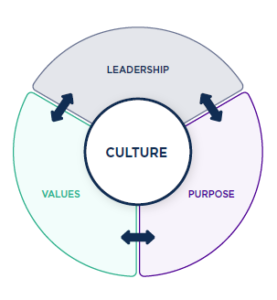
This article focuses on how the new ways of working required by this cultural shift can be sparked—and led—from within the ethics and compliance team.

Founded on shared values
At the heart of this revolution is the emergence of an accountability culture. We are holding leaders, organizations and societies accountable at unprecedented levels, fueled by social media and the power that this gives one voice to be heard and amplified thousands of times over.
When we hold these groups accountable, we have to question what we are holding them accountable for. In some cases, it is our own sense of right and wrong. In many cases, we are holding them accountable to their own brand promise, their values. Quite simply, are they doing what they said they would do?
Many CEOs have recognized that they can no longer stay silent on burning social issues. The historical wisdom of staying silent to avoid offending customers, employees and other stakeholders, or getting into trouble, is outdated and short-sighted.
This attitude has been replaced with the recognition that failure to take a stand, for or against, is seen as insincere1, lacking integrity, and ultimately offensive to everyone.
…The analysis reveals that there is no correlation between the cultural values a company emphasizes in its published statements and how well the company lives up to those values in the eyes of employees. All of the correlations between offcial and actual values were very weak, and four of the nine — collaboration, customer orientation, execution, and diversity — were negatively correlated.
Taking a stand, however, that is not consistent with an organization’s brand and perceived values is also quickly punished by consumers. Insincerity is transparent and spotted rapidly these days. There is no escape from scrutiny.
It is therefore critical that leaders (at all levels) focus on understanding, influencing and living the values of the organization that they head up. A set of shared values needs to be exactly that: shared and real, not just catchy phrases built into striking artwork in the halls of head o‑ce, but essential to molding an intentional culture.
For many organizations, the true values are never spoken and are radically different, even opposed, to the ‘published’ values on the company website. To understand a culture we must first seek to uncover these true values. Only by first acknowledging them, and understanding the consequences of them, can we start the process of changing them. Common sense tells us that if you say you stand for something, anything, that you will need to demonstrate it if you want people to trust you.
Brand loyalty, from internal or external stakeholders is based on this consistency, so why do most companies fall down when it comes to living their values?